
Picture two plumbers in the same postcode. One has a flawless 5.0 rating from eleven reviews. The other sits at 4.7 stars from three hundred and fifty. Who gets the call?
Most business owners assume it’s the 5.0. Almost every shopper will actually tap the 4.7 — and not because of the review count. Something about a perfect rating makes people uneasy. They start wondering who the reviewers are, whether friends wrote them, whether the business is quietly deleting the bad ones. In that moment of doubt, they scroll to the next result.
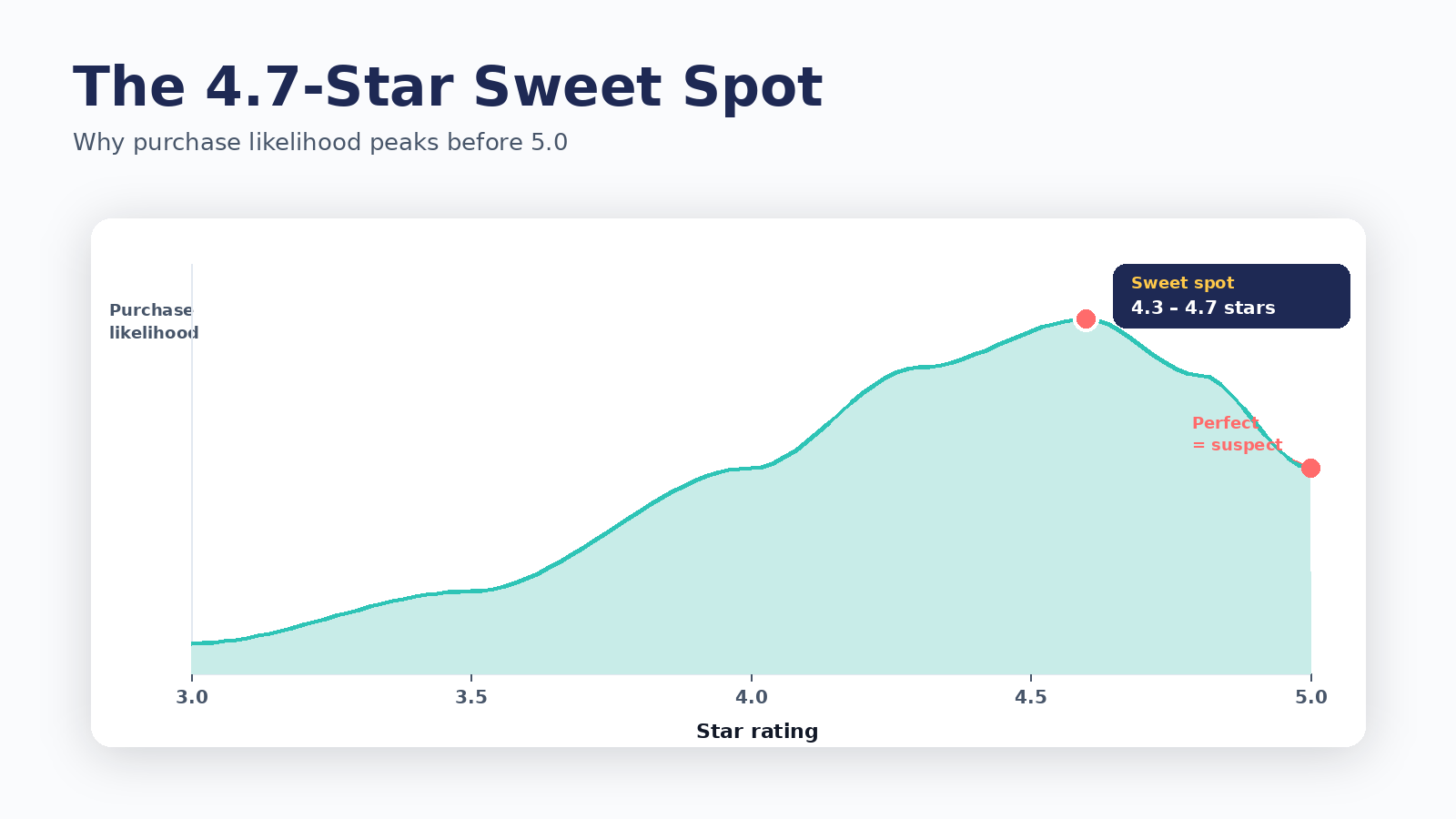
This is the counterintuitive finding that Northwestern’s Spiegel Research Center landed on years ago and that every review platform has since confirmed: purchase likelihood does not climb in a straight line with your rating. It peaks somewhere between 4.2 and 4.7, and then it drops as you approach 5.0. If you’ve been chasing a perfect score, you’ve been chasing the wrong target.
The hidden cost of chasing 5.0
When shoppers see a flawless rating, a small alarm goes off. Research from 2025 found that 46% of consumers actively distrust perfect 5-star ratings — and that number climbs to 53% among Gen Z. Around 82% of shoppers deliberately seek out the negative reviews before they’ll buy, because a handful of honest 2-star complaints tells them the positive ones are probably real.
This isn’t vanity psychology. It costs you money.
- The average Google rating for a local business is 4.42 stars. If your page looks too good compared to that, you stand out for the wrong reason.
- 87% of consumers won’t consider a business under 4.0 stars, but the conversion peak sits narrowly in the 4.3 to 4.7 band. Above and below that window, clicks taper off.
- A 4.5-star business earns up to 25% more clicks than a 3.5-star one — and often more clicks than a 5.0 with a thin review count.
- 73% of consumers only trust reviews from the last 30 days. A 5.0 built on two-year-old reviews reads as a stale trophy, not a live business.
The real problem with a perfect rating is that it signals the wrong thing. It says “we have eleven friends” instead of “we serve hundreds of people and most of them are happy.” Your prospect can’t tell the difference between a curated score and a captured audience — so they assume the worst.
Three ways to land in the sweet spot on purpose

Getting to 4.7 and staying there is more interesting than pushing for 5.0. It requires you to stop treating every sub-5 review as a catastrophe and start treating your review page as a credibility engine.
1. Stop suppressing your moderate reviews
If you’ve been asking unhappy customers to “let us know directly before leaving a review,” cut it out. You’re not protecting your rating — you’re hollowing it out. Prospects can smell a filtered profile. A page with nothing but glowing five-stars and no texture reads as a page that’s been pruned.
Instead, welcome the 3s and 4s. They are the reviews that make the 5s believable. A thoughtful 4-star review that says “great food, service was a bit slow on Saturday” does more to validate your 5-star reviews than three more 5-stars ever could. Buyers actively look for this kind of review. When they can’t find it, they get suspicious.
2. Prioritise review velocity over review score
One of the least-talked-about stats in local SEO: 73% of consumers only trust reviews from the last thirty days. Google’s algorithm weights recency heavily, and so do your prospects. A business with 12 reviews in the last month and a 4.6 rating outranks — and outconverts — a business with 200 historical reviews at 4.9 but nothing new since last October.
The practical version of this: set a target of at least four fresh reviews every month. It’s more sustainable than a one-off “review drive,” it looks more natural to Google’s spam filters, and it keeps your star average hovering in the credible zone instead of freezing at an unnatural 5.0.
3. Respond to every review — especially the lukewarm ones
Businesses that reply to every review are converting at more than 5.1% in 2025, materially above non-responders. But the real leverage isn’t in thanking your 5-star fans. It’s in how you handle the 3s and 4s.
A 3-star review that says “nice people but the app kept crashing” is a gift. Responding to it publicly with “Hi Sarah — you’re right, we shipped a buggy build in March. Fixed in the April release. If you’d give it another try I’d love to know if it holds up for you.” — that response isn’t for Sarah. It’s for the 400 prospects who’ll read it over the next year and think, these people actually listen. One good response to a mediocre review converts more skeptics than ten “Thanks for the kind words!” replies ever will.
Where the sweet spot really pays off

The reason 4.7 outperforms 5.0 isn’t really about the number. It’s about what the number signals to a person deciding whether to trust you with their money.
At 5.0, a prospect has to choose between two stories: either this business is mythically perfect, or the reviews have been curated. Neither is comforting. At 4.7, the story writes itself — most people love it, a few had off days, the business responded like grown-ups, and real life is happening here. That’s a business a reasonable person can say yes to.
This also changes how the rest of your marketing has to work. A 5.0 page needs to defend itself against skepticism — you end up overexplaining, over-sourcing, over-promising. A 4.7 page does the defending for you, so your landing page, your ads, and your sales calls can focus on the actual offer. Your whole funnel gets simpler when the reviews are doing the trust-building quietly in the background.
What “good” looks like in practice
A healthy Google review profile in 2026 typically has:
- A star rating between 4.3 and 4.8 — not higher, not lower.
- At least three to four new reviews per month, year-round.
- A visible mix of 3s, 4s, and 5s, with honest-sounding language across them.
- A public response from the business on every review, within a week of posting.
- Thoughtful, individualised replies to the lukewarm ones — not copy-pasted apologies.
- At least a handful of reviews with customer photos, which now carry extra weight with Google’s ranking signals.
If your profile is missing two or more of these, the fix isn’t “get more 5-star reviews.” It’s to stop filtering, start replying, and let the honest signal come through.
The bottom line
Chasing a perfect Google rating is the local-SEO equivalent of running your marketing budget through a paper shredder. The customers you’re trying to impress aren’t impressed — they’re suspicious. The ones you actually convert are the ones who see a business that looks real: mostly happy, occasionally imperfect, consistently responsive, and unafraid of honest feedback.
Pick one thing this week. Open your Google Business Profile, find the most recent 3- or 4-star review, and write a public reply that would make a stranger nod in respect. That one reply will do more for your next hundred customers than a month of chasing another five-star.
If you want more than a one-line tactic — the full workflow for landing in the sweet spot, responding well, and keeping review velocity high without it becoming another thing on your plate — come and see what we do at SmtProcess. We help small businesses turn their Google profile into a credibility engine that works quietly in the background.
Or, if you’d rather a second set of eyes on your own Google profile first — review mix, response tone, velocity — drop a link in the comments and I’ll tell you what a prospect actually sees.
Leave a Reply