
Think about the last time you walked into a store where no one greeted you, no one asked what you needed, and the front counter was empty. How long did you stick around?
That’s what most websites feel like right now.
They’re online brochures. Pretty photos, a list of services, a phone number buried in the footer, and a contact form that sends an email into a black hole. In 2026, that isn’t a website — it’s a missed opportunity on repeat.
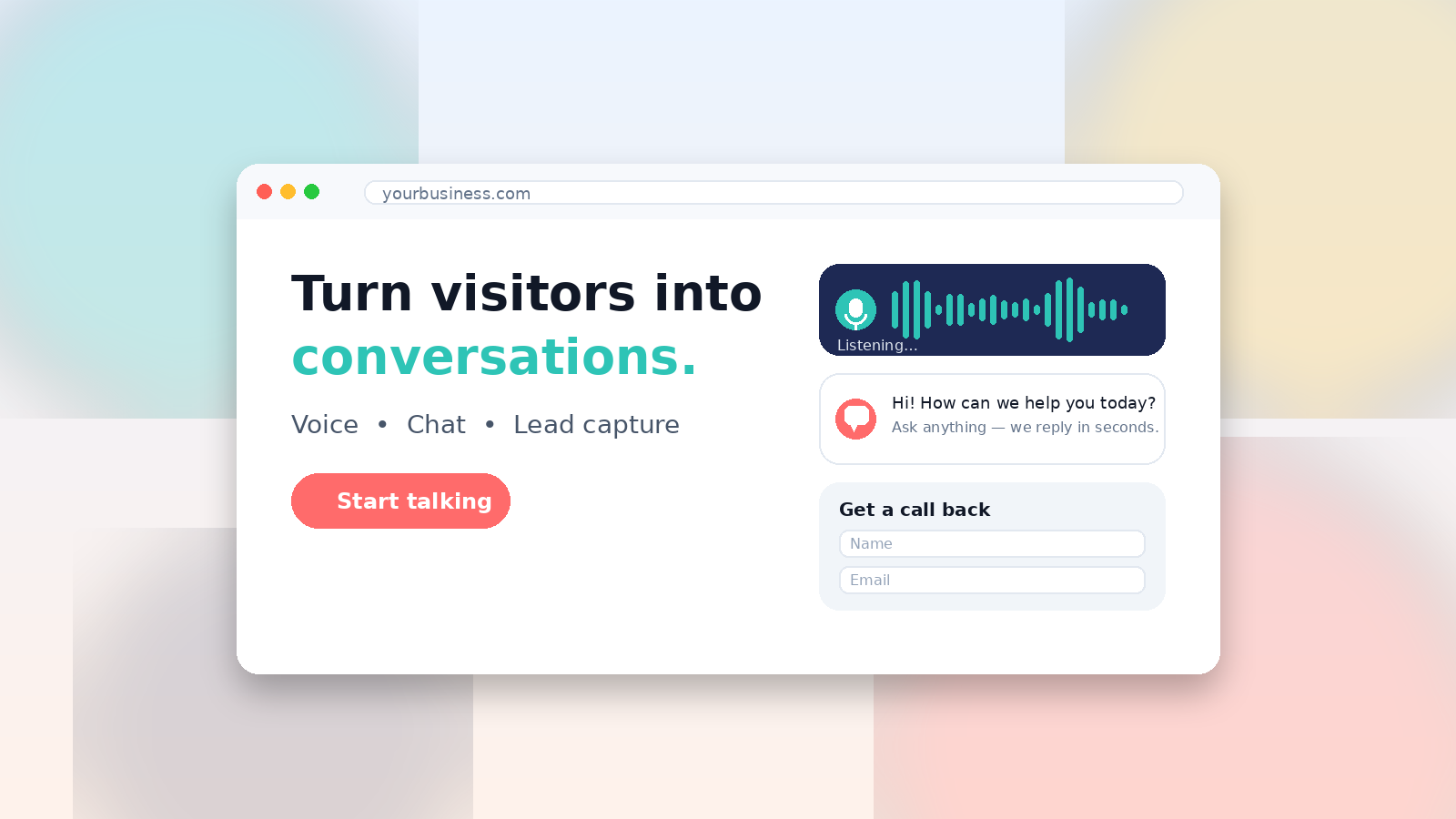
Your website should be your best salesperson. Available 24/7, never in a bad mood, and ready to strike up a conversation the second someone walks in the door. Here’s why making your site talk, chat, and collect lead information is one of the highest-leverage moves you can make this year — and how to actually pull it off.
The cost of a silent website
Most people won’t call. Most won’t fill out a form. And almost no one will email you with a question before they’ve made up their mind. Visitors arrive, skim, and leave — usually in under a minute. If nothing on the page invites them into a conversation, they’re gone, and you never even knew they were there.
A few realities worth sitting with:
- The vast majority of first-time visitors never come back.
- Leads contacted within five minutes are dramatically more likely to convert than leads contacted an hour later (a classic Harvard Business Review finding that’s held up across industries).
- People expect to get an answer the same way they’d get one from a friend — by asking.
A static website can’t meet any of those expectations. A conversational one does it effortlessly.
Three ways to turn browsing into a conversation

1. Voice chat — let people talk, not type
Voice is the shortest path from “I have a question” to “I have an answer.” No typing. No forms. Just tap a button and ask.
For service businesses especially — home services, clinics, real estate, salons, restaurants — voice chat feels natural to the kind of customer who’d normally pick up the phone. The difference is that your website is open at 10pm on a Sunday, and a well-configured voice assistant can qualify the question, answer the easy stuff, and collect contact details for anything that needs a human.
Real-world wins from adding voice:
- Customers who hate typing (or are driving, cooking, holding a baby) can still get help.
- Accessibility goes up for visitors with low vision or motor difficulties.
- You hear what your customers are actually asking — a goldmine for marketing and FAQs.
2. Live or AI text chat — reply in seconds, not days
Text chat is the workhorse. It’s familiar, low-commitment, and it works beautifully on a phone. A small chat bubble in the corner of your site takes up almost no space, but it changes the whole vibe: “There’s a person (or a smart helper) here, and I can ask anything.”
Done well, chat can:
- Answer the five questions every visitor has (“Do you service my area?” “How much?” “When are you open?”) before they even think about leaving.
- Hand off to a human when the question gets real — with the conversation history attached.
- Book appointments, quote simple jobs, and share relevant pages without a human lifting a finger.
You don’t need a 24/7 support team to make this work. A modern AI chat can handle the first wave, capture the lead, and tee up a human follow-up for the morning.
3. Lead capture — turn every conversation into data you can act on
A conversation that ends without contact information is just a nice chat. The magic happens when you turn “Hi, how can we help?” into a name, an email, a phone number, and a clear sense of what the person actually wants.
The best sites weave lead capture into the flow instead of treating it like a tollbooth:
- Ask for the name early, in a friendly way (“Who am I chatting with?”).
- Ask for contact info after you’ve given value, not before.
- Capture intent alongside contact details — the service they asked about, the zip code, the budget, the urgency. That context is what makes follow-up useful instead of annoying.
Where lead data really earns its keep: follow-up workflows

Capturing a lead isn’t the finish line. It’s the starting pistol.
Once that name and email hit your system, a well-built website fires off a chain of follow-ups that would take a team of humans to run by hand:
- Instant confirmation. A friendly email or text lands in the visitor’s inbox within seconds: “Thanks for reaching out — here’s what happens next.” This alone builds more trust than 90% of your competitors are offering.
- Smart routing. Based on what the lead said, the request goes to the right person: sales for a quote, support for an issue, a booking link for an appointment.
- Reminder sequences. If they don’t book right away, gentle follow-ups over the next days and weeks keep you top of mind without anyone remembering to press send.
- Re-engagement. Old leads who went quiet get a “still interested?” nudge at the right moment, often bringing them back months later.
- Analytics that matter. You finally know which pages, ads, and campaigns actually produce conversations — not just clicks.
All of that runs in the background while you focus on the work. Your website isn’t just a digital storefront anymore. It’s the front door, the greeter, the intake form, and the CRM assistant all rolled into one.
What “good” looks like in practice
If you want a simple checklist to benchmark your own site against, here it is:
- A visitor can start a conversation within two seconds of arriving — voice, chat, or both.
- Common questions get answered instantly, without the visitor having to read a wall of text.
- Every conversation ends with either a booked action (call, appointment, order) or captured contact info.
- New leads trigger an automatic, friendly follow-up within minutes.
- You have a single place to see every lead, where they came from, and what they said.
If even one of those is missing, there’s money being left on the table.
The bottom line
A website that just sits there is a brochure. A website that talks, listens, and remembers is a business asset — one that quietly pays for itself by turning traffic you’re already getting into real customers.
The tools to do this are cheaper, smarter, and easier to deploy than ever. The question isn’t whether conversational features belong on your site. It’s how much longer you can afford to go without them.
If your site is still playing the silent-brochure role, this is the year to fix it. Start with one channel — chat is a great first step — get the lead data flowing, and build out from there. Every conversation you enable is a customer you didn’t lose.
Ready to turn your website into a conversation machine? Let’s talk — or better yet, use the chat bubble in the corner. That’s kind of the point.

Leave a Reply