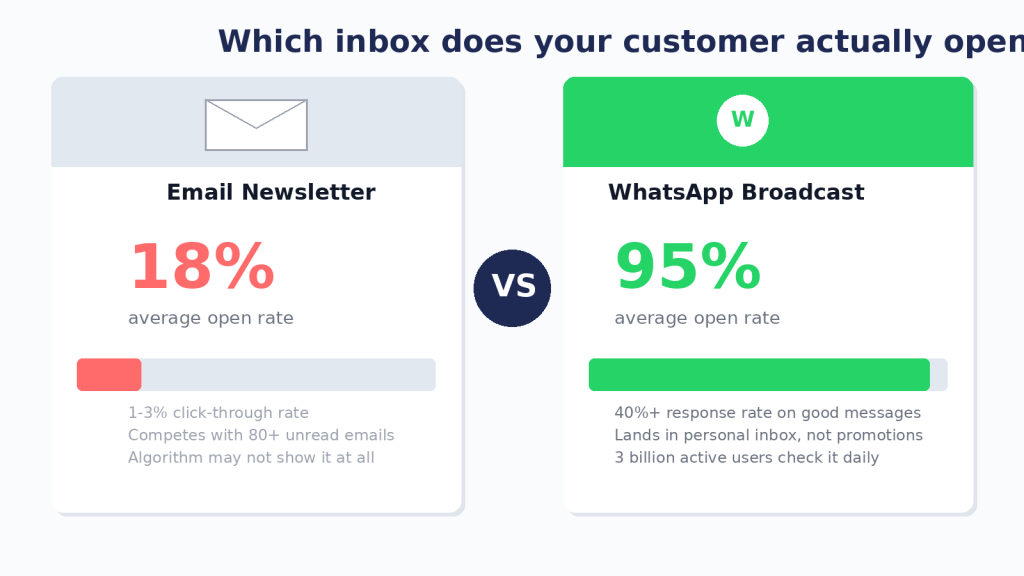
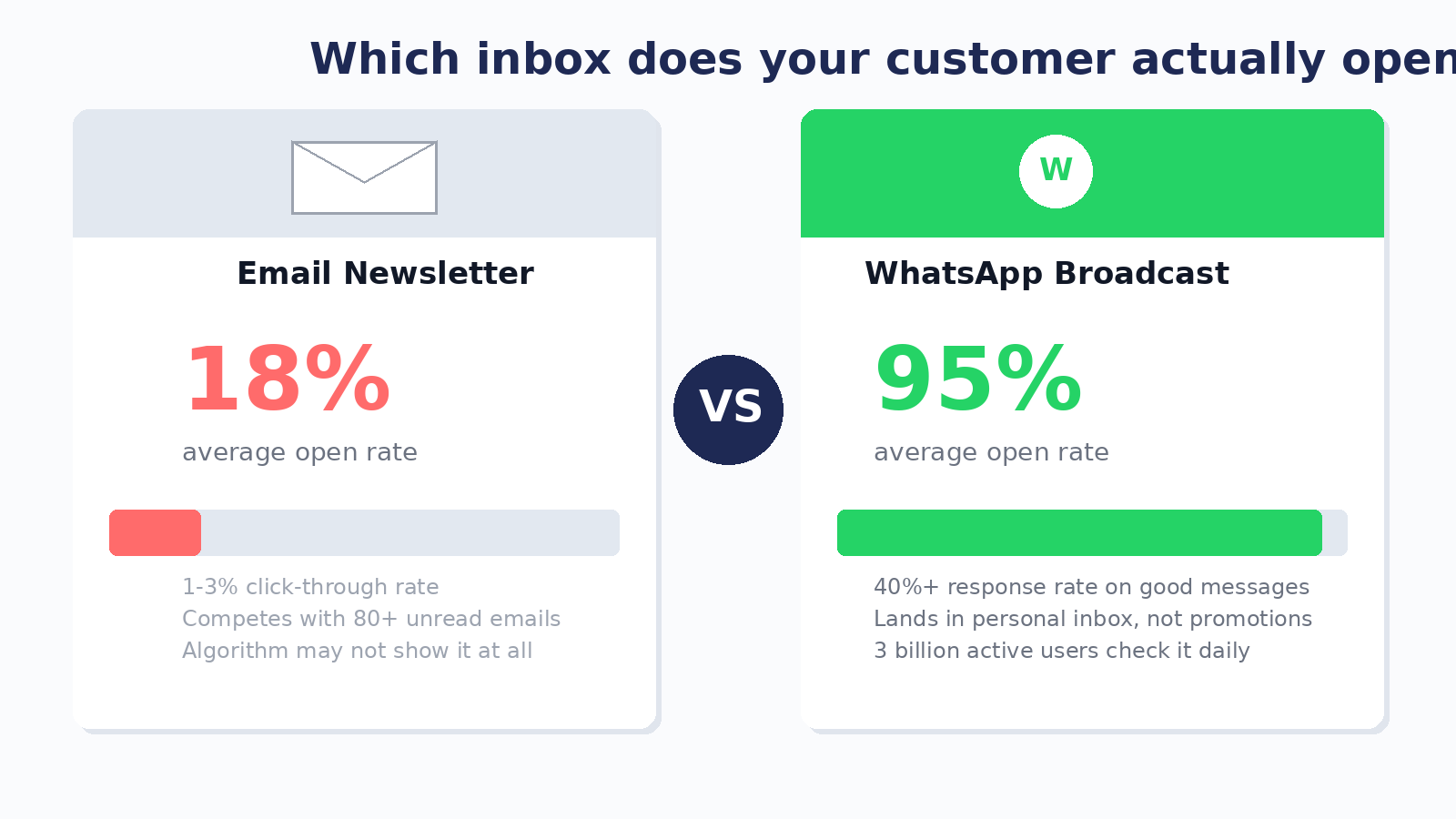
Picture this: you send out a beautifully designed email newsletter to 500 customers. Two days later, you check the open rate. 18%. The industry average. Half of those opens were probably someone clicking by accident on their phone.
Now picture the same message sent as a WhatsApp broadcast. Within an hour, more than 400 people have seen it. Dozens have replied. A handful have already bought.
That is not a hypothetical. That is the gap most businesses are quietly leaving on the table.
The cost of shouting into the void
Most small and mid-sized businesses still treat email and social media as their primary direct channels to customers. The problem is not that those channels are dead. It is that they are crowded, algorithmic, and increasingly ignored.
Consider what the average customer sees in a day. Their email inbox has 80 unread messages, most of them promotional. Their Instagram feed is curated by an algorithm that decides whether your post even gets shown. Their Facebook page might not have surfaced your update in weeks.
WhatsApp is different. It has open rates north of 90% and response rates that make email marketers weep into their CRMs. When a customer’s phone buzzes with a WhatsApp message, they look. Almost every time.
If you are not using broadcasting, you are choosing to compete in the noisiest rooms while leaving the quiet one empty.
Three ways WhatsApp broadcasting changes the game
The mechanics are simple. A broadcast list lets you send a single message to many people at once, but each recipient receives it as a private one-to-one chat. No group thread. No replies visible to other recipients. Just a personal message that happens to be sent at scale.
Here is where the leverage actually shows up.
1. Open rates that do not feel like a fantasy
The numbers around WhatsApp engagement read like marketing fan-fiction until you see them in your own dashboard. Open rates typically sit between 90% and 98%. Response rates can hit 40% or higher for well-crafted messages. Compare that to email’s 1 to 3% click-through rate and you start to understand the difference in kind, not just degree.
The reason is structural. WhatsApp lives on the home screen of nearly three billion phones. It is the app people check between meetings, in lifts, in queues. Notifications are personal by default. Your message is not fighting an algorithm or a promotions tab. It is landing in the same place their best friend’s message lands.
2. Conversations, not announcements
Email and social posts are megaphones. WhatsApp is a conversation. When someone receives your broadcast, replying takes one tap. No reply-to-this-email-and-someone-will-get-back-to-you-within-three-business-days. No forms, no logins, no friction.
That changes what marketing even means. A broadcast announcing a new product becomes a sales conversation when the first interested customer hits reply. A reminder about an appointment becomes a quick reschedule when something comes up. A weekly tip becomes a relationship.
For service businesses, this is gold. Hairdressers confirming appointments. Restaurants taking pre-orders. Coaches checking in on clients. The broadcast starts the conversation; the conversation closes the loop.
3. Segmentation that respects your customer
The best broadcast lists are not lists of everyone who ever gave you their number. They are segments, small deliberate groups built around what those customers actually care about.
Loyal regulars get a different message than first-time visitors. Customers who bought last month do not get the same offer as customers who have not bought in six. Local customers get the in-store event invite; everyone else gets the online-only equivalent.
This kind of segmentation is theoretically possible in email, but in practice almost nobody does it well. With WhatsApp broadcast lists, it is the default. You build the list with intention, and the small size keeps the messaging honest.
Where the real magic happens: turning broadcasts into a system
Here is the part most businesses miss: a single broadcast is a tactic. A rhythm of broadcasts is a strategy.
The businesses that get extraordinary results from WhatsApp are not blasting their entire customer base once a month with a flyer. They have built a quiet, predictable cadence, usually one to four broadcasts a month, each one tightly focused, each one earning the right to send the next.
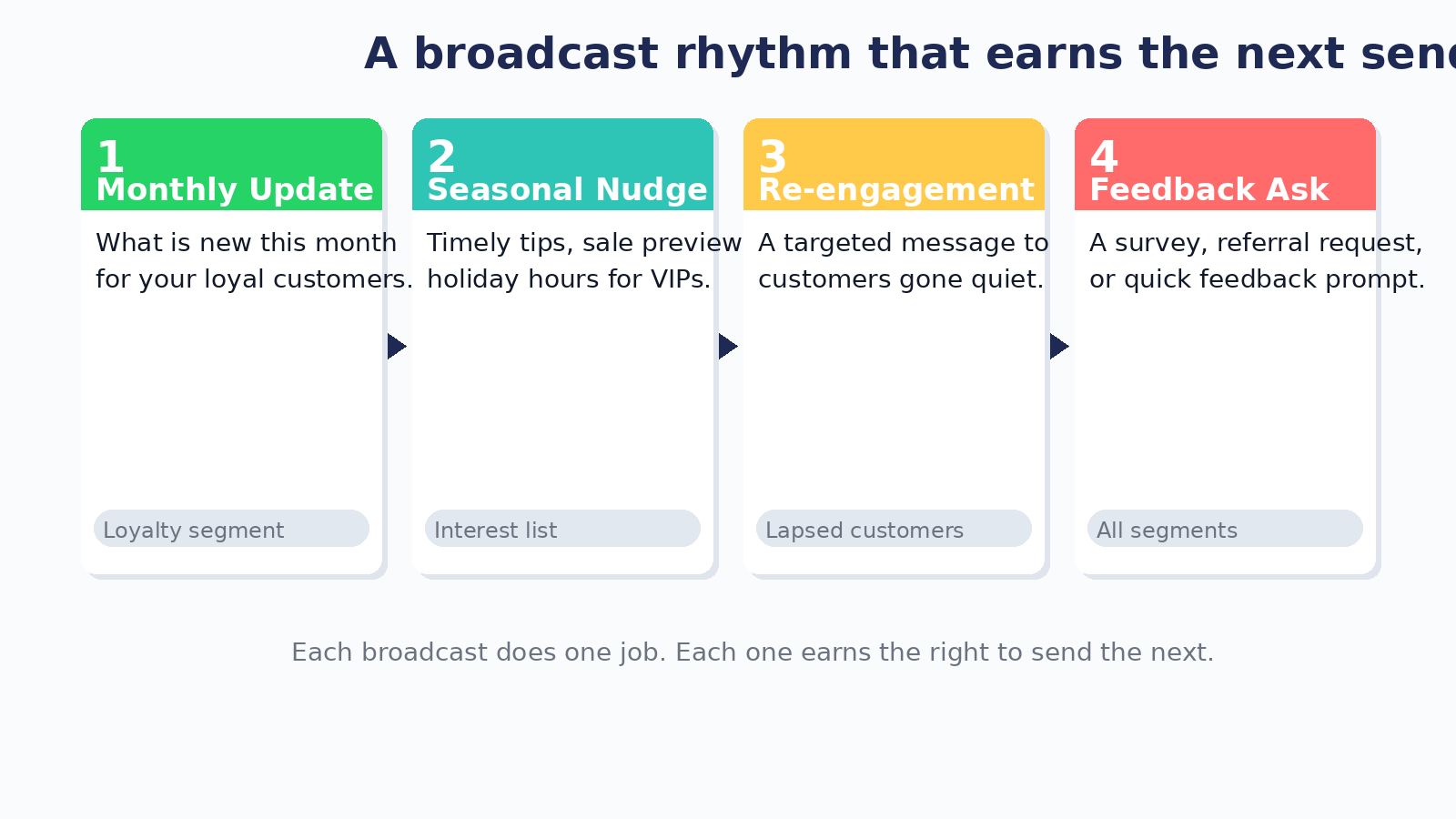
A practical rhythm might look like a monthly what-is-new message to your loyalty segment, a timely tip or seasonal nudge to your interest-based list, a targeted re-engagement message to customers who have gone quiet, and an occasional ask, such as a quick survey, a referral request, or a feedback prompt, that treats the customer as a partner rather than a target.
Each broadcast does one job. Each one leaves the customer slightly better off for having received it. Over time, that compounds into something email never quite manages: a list of people who actually look forward to hearing from you.
The other piece worth naming: WhatsApp broadcasting works beautifully alongside everything else you are doing. It is not a replacement for your email list or your social presence. It is the channel you reach for when the message actually matters and when you genuinely need someone to see it now.
What good looks like in practice
Before you hit send on your first broadcast, run the message through this short checklist:
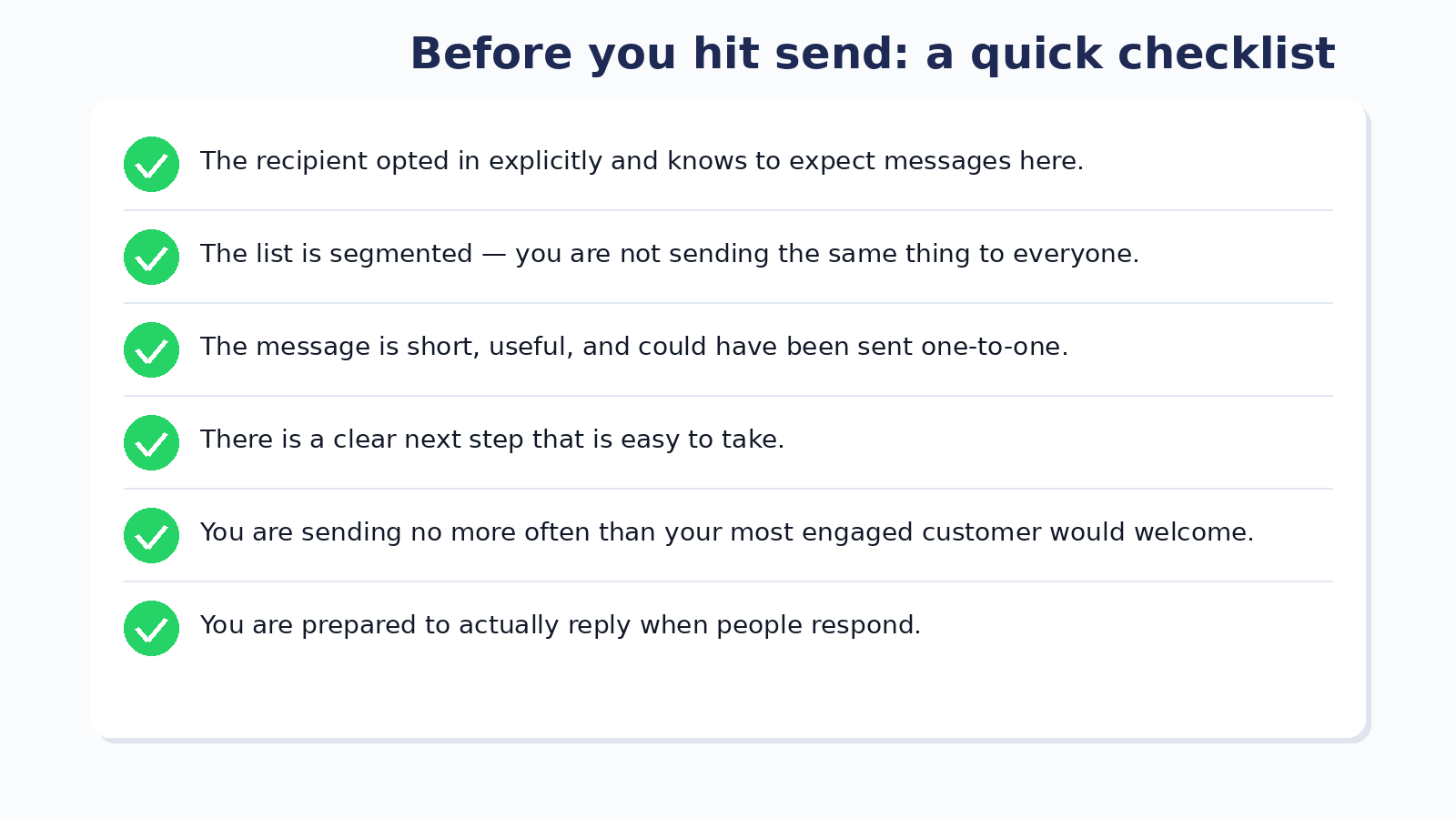
- The recipient opted in explicitly. They know they will hear from you here, and they said yes.
- The list is segmented. You are not sending the same message to everyone.
- The message is short, useful, and feels like it could have been sent one-to-one.
- There is a clear next step, whether that is reply, book, click, or show up, and it is easy to take.
- You are sending no more often than your most engaged customer would welcome.
- You are prepared to actually reply when people respond. This one trips up more businesses than any other.
If you can tick all six, send it. If you cannot, fix what is missing first.
The bottom line
WhatsApp broadcasting is not a silver bullet, and it is not a replacement for the rest of your marketing. What it is, is the highest-signal direct channel most businesses have access to right now, and it is quietly being underused while everyone else fights for attention in inboxes and feeds.
If you have been waiting for a sign to try it, this is it. Start with one segment. Send one thoughtful message. Reply to everyone who replies back. Then do it again next month with what you learned.
The hardest part is not the technology. It is getting comfortable with the idea that a channel this direct demands you actually have something worth saying.
If you want help building a broadcasting rhythm that fits your business, without sliding into spam, that is exactly the kind of conversation worth having. Hit reply.

Leave a comment