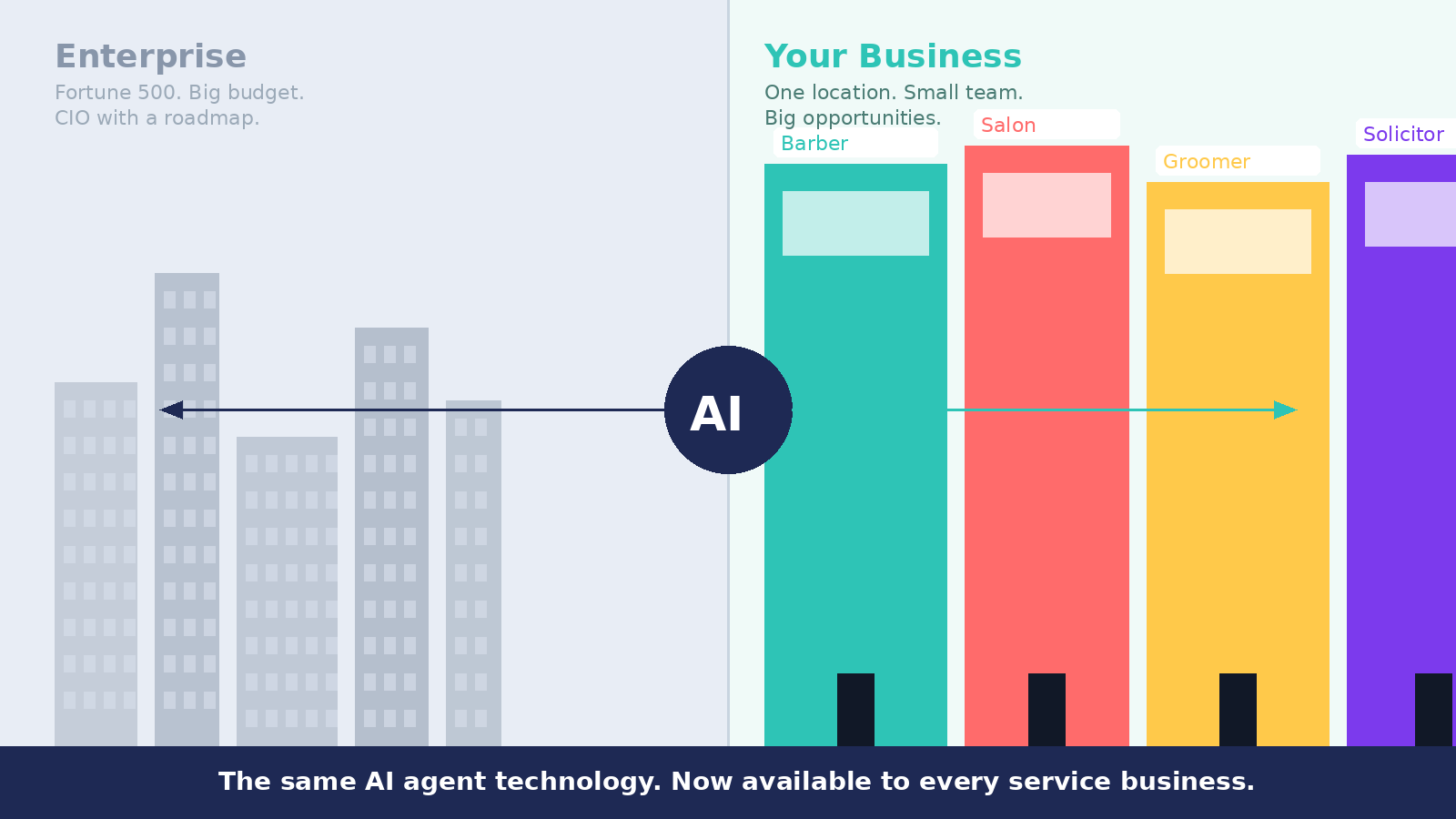

You have probably read the headlines. AI agents are transforming enterprise operations. The market is growing at 45.5% annually. Fortune 500 companies are deploying autonomous systems that handle entire workflows without human involvement. Investors poured over 2.8 billion dollars into agentic AI in the first half of 2025 alone.
And if you run a barbershop, a dog grooming salon, a solicitors practice, or a tattoo studio, you probably read all of that and thought: good for them.
Here is the part those articles leave out. The same technology is available to you right now. Not a watered-down version. Not a toy chatbot bolted onto a website. The actual thing. And the businesses using it are not multinationals with IT departments and seven-figure automation budgets. They are one and two-location service businesses that decided to stop waiting for someone to build it for them.
What an AI agent actually is, in plain English
Strip away the hype and an AI agent is simply a system that takes action on your behalf without you needing to trigger it manually each time. It watches for events, makes decisions based on rules and context, and executes tasks across multiple tools and channels.
For an enterprise, that might mean an agent monitoring global supply chains, coordinating with supplier agents, and rerouting shipments before a delay happens. The scale is different when you run a service business, but the principle is identical.
For a barber: a client calls at 7pm, gets a missed-call text-back within thirty seconds, books an appointment via the reply, and receives a reminder the day before. At no point did the barber touch their phone. That is an AI agent doing its job.
For a solicitor: a website enquiry comes in at 11pm, the AI qualifies it, answers initial questions about fees, logs the lead to the CRM, and fires a follow-up sequence. By the time the solicitor arrives on Monday morning, the lead is warm and the groundwork is done. Again: no human involvement.
That is agentic AI. It is not magic. It is just automation that thinks a step ahead rather than waiting to be told what to do.
The enterprise market tells you where this is going
The reason those enterprise headlines matter, even if you run a two-chair salon, is that they tell you where the floor is moving. When 40% of enterprise applications will embed task-specific AI agents by 2026, that is not a niche trend. That is the new baseline expectation for what software does.
And when enterprise software sets a new baseline, the tools that serve small businesses follow. They always have. CRM software was enterprise-only in the 1990s. Email marketing was out of reach for most small businesses in 2005. Automated booking systems cost tens of thousands a year a decade ago.
AI agents are at that inflection point right now. The infrastructure exists. The cost has come down. The only question is whether you are an early adopter who builds a compounding lead, or whether you wait until your competitors have already figured it out.
What your AI agent does while you are with a client
Here is the most useful way to think about it. Every minute you are doing the actual skilled work you trained for, there is a parallel set of business tasks that either get done or do not get done. Calls get answered or they do not. Leads get followed up or they go cold. Happy customers get asked for a review or they forget. Lapsed clients get nudged or they quietly book with someone else.
Without an agent, those tasks depend on you finding time. With an agent, they happen regardless.

A missed call at 8:14am triggers an immediate text-back. A website enquiry at 9am gets qualified and answered. A completed appointment at 11:30 prompts a review request while the experience is still fresh. A client who has not visited in six weeks gets a personalised re-engagement message at 1:45pm. By 5pm, your CRM has a full log of every interaction, every lead, every outcome.
You did none of that. You were working.
The five-layer agent stack for service businesses
Enterprise deployments talk about multi-agent systems with specialised roles handling different parts of a workflow. For a service business, the architecture is simpler but the principle is the same. A well-built local agent stack has five distinct jobs:

1. Capture
Every inbound signal, whether a phone call, a website form, a Facebook DM, or an Instagram enquiry, gets logged automatically. Nothing falls through the cracks. The agent does not forget, does not get busy, and does not need reminding.
2. Qualify
The agent identifies which enquiries are serious, answers common questions about services and pricing, and filters out the noise. A hot lead gets escalated immediately. A time-waster gets a polite automated reply that never comes back to you.
3. Convert
Qualified leads get a booking link, a follow-up sequence, or a targeted offer, delivered at the right moment. The agent does not give up after one touchpoint. It works the lead through multiple contacts until the person books or explicitly opts out.
4. Retain
Existing clients get appointment reminders, rebooking nudges, and loyalty messages. Lapsed clients get reactivation sequences. The agent knows who has not been in recently and takes action before they drift to a competitor.
5. Reputation
After every appointment, the agent sends a review request timed to hit when the client is most likely to act. Over months, this compounds into a Google profile that consistently outranks competitors on volume and recency, the two factors that actually drive local search ranking.
Why small businesses actually have an advantage here
Here is something the enterprise articles will never tell you: when it comes to implementing AI agents, small service businesses have a structural advantage over large organisations.
Enterprises face change management at scale. Rolling out a new agent-based workflow to thousands of employees across dozens of departments takes months of planning, politics, and training. The technology is ready long before the organisation is.
A two-person barbershop can be fully live in a week. There is no procurement process, no IT committee, no legal sign-off for a chatbot. The owner decides, the system gets set up, and by Monday it is answering calls and sending review requests.
That agility is an asset. The businesses that move first in a local market build a review profile, a rebooking rate, and a lead conversion rate that is genuinely difficult for slower competitors to close the gap on. Every week the agent is running, the lead compounds.
What to look for in a real implementation
Not all automation is agentic. A lot of what gets sold to small businesses as AI is glorified scheduling software or a basic autoresponder. The difference worth paying attention to:
- Does it take action based on events, or does it only respond when you trigger it manually?
- Does it work across multiple channels, calls, SMS, email, social, or just one?
- Does it update your CRM automatically, or do you still have to log things yourself?
- Does it have a follow-up sequence that persists across multiple touchpoints, or does it send one message and stop?
- Does it have a voice component that can handle real phone calls, or only text?
A proper agent stack ticks all five. A basic chatbot ticks one, maybe two. The gap in results is not subtle.
The window is open, but it will not stay open
The AI agent market growing at 45.5% annually is not a statistic about technology. It is a statistic about competitive dynamics. At that rate of adoption, the local markets that are currently wide open, where one business with a proper agent stack can dominate search rankings and capture a disproportionate share of enquiries, will not stay wide open for long.
The enterprise revolution that everyone is writing about is real. But the local revolution is the one that will actually affect your diary, your Google ranking, and your monthly revenue. It is quieter, it is faster to implement, and it is happening right now in service businesses that look a lot like yours.
The question is the same one the enterprise articles keep asking: are you building the lead, or will you be catching up?
If you want to see what a five-layer agent stack looks like for your specific type of business, the Smart Process AI team builds and manages these systems for local service businesses across the UK. No jargon, no enterprise price tag. Just a system that works while you do.
Leave a Reply